


The bigger story behind the new risk score
Major Shift in the Government’s View of Water Resilience
Major Shift in the Government’s View of Water Resilience
The UK Government recently published its latest National Risk Register, which outlines the most serious risks currently facing the UK.
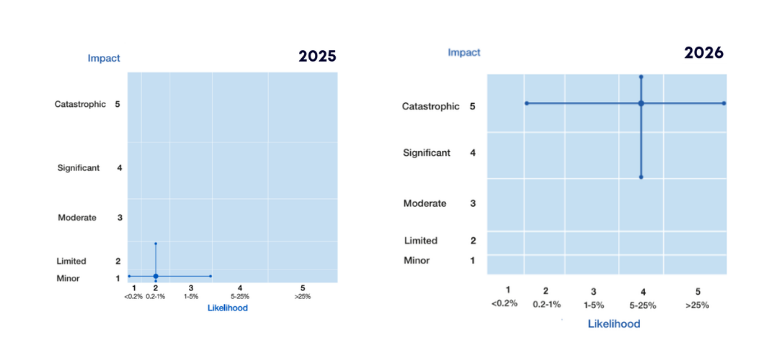
This year saw a dramatic change in the Government’s assessment of a water infrastructure failure. Whilst the likelihood and impact ratings have increased significantly, the bigger story is the change in the assumptions about what a major water incident might look like.
A shift in assumptions
- Failure of one or more treatment works
- Failure of critical water infrastructure serving a large urban area
- Contingency plans, mutual aid and alternative water supplies expected to support recovery
- An incident of this scale could overwhelm the sector’s ability to provide alternative water through tankers and bottled water alone
- Focused on operational disruption
- Considers wider consequences including evacuation, shelter and government intervention
The shift is striking. Just 12 months ago, the Government was assessing a relatively localised operational incident. Today, it is considering a scenario that could affect more than one million people and require a national-level response.
More significantly, it acknowledges that an incident of this scale could overwhelm the water sector’s ability to provide alternative supplies through tankers and bottled water alone.
The implications extend well beyond restoring water supplies. The Register now considers wider national consequences, including the potential need for coordinated government intervention, evacuation, shelter and a broader multi-agency response.
The Register does not explain why the assessment has changed. What it does show is that the assumptions underpinning the scenario are now fundamentally different.
This new scenario recognises that the consequences of a major water infrastructure failure extend far beyond access to drinking water, with potential disruption to businesses, healthcare, education and other essential services, while also acknowledging that infrastructure repairs could take months rather than days.
Taken together, these changes suggest a growing recognition that water resilience is not solely a utility challenge. It is an organisational resilience challenge too.
So what can we learn from this?
For water-dependent businesses, this acknowledgement by the Government of the potentially catastrophic consequences of a major water infrastructure failure should be a call-to-action to revisit their own fundamental assumptions about operational resilience.
- How long could we continue operating without a mains water supply?
- Which services are truly business critical?
- What would the impact be if disruption lasted weeks or even months rather than days?
- Are our continuity plans based on the incidents of yesterday, or the scenarios the Government is now planning for?
The Register doesn’t suggest these events are inevitable.
What it does tell us is that resilience planning cannot stand still. As our understanding of risk evolves, so too must the assumptions that underpin business continuity and operational resilience.
For organisations, that may mean looking beyond traditional contingency measures and taking a broader view of water resilience – understanding dependencies, assessing operational vulnerabilities and considering how critical services would be maintained during an extended disruption.
Whether the Government’s shift in thinking reflects changing threats, new intelligence or a deeper understanding of systemic vulnerabilities, the implication for organisations is the same: assumptions that once felt reasonable may no longer be sufficient.
The question is not whether a major water incident will occur tomorrow. It is whether resilience plans are keeping pace with the scenarios being considered today.
Share: